
Summary
Editor's rating
Is it worth the money compared to cheaper chargers?
Compact metal build that doesn’t look cheap
Simple packaging, nothing fancy but does the job
Build quality and how it holds up with regular use
Real-world charging speed and behaviour on the road
What you actually get and how it’s supposed to work
Pros
- Genuinely fast charging on the USB‑C port when used alone
- Sturdy metal build and compact design that sits almost flush in the socket
- Included 60W braided USB‑C cable is good quality and useful for modern phones and tablets
Cons
- Very tight fit in some sockets, can be awkward to pull out
- Fast charging drops noticeably when two devices are plugged in at once

Specifications
View full product page →| Brand | LISEN |
A small charger that actually keeps up with modern phones
I’ve been using this LISEN car charger for a few weeks in a 2016 diesel estate and occasionally in a small petrol city car. I bought it because my old plastic charger struggled to keep my phone alive when using Google Maps and Spotify at the same time. The phone would charge, but very slowly, and sometimes it would even lose battery while navigating. With this one, I wanted something that was small, didn’t feel cheap, and could handle fast charging properly.
In day-to-day use, the first thing I noticed is that it just sits in the socket and doesn’t wobble or disconnect over bumps. I drive on a lot of rough B-roads and speed bumps, and my previous charger would randomly stop charging when it moved slightly. With this LISEN one, the connection has been stable so far. You plug it in, it clicks into place, and that’s it. No fiddling around every 10 minutes to get the charging icon back on the phone.
I’ve mainly used the USB‑C port with the included cable to charge a Samsung phone and a USB‑C iPad. I’ve also tried the USB‑A port with an older cable for a passenger’s iPhone. In practice, the fast-charging claim is mostly accurate on the USB‑C side when you’re only charging one device. When you plug two things in at once, it still charges, but you clearly feel it slow down, which the brand actually admits in the description. So don’t expect two phones to jump from 10% to 80% in half an hour at the same time.
Overall, my first impression is that it’s a pretty solid little charger that does what I wanted: keeps the phone topped up even with navigation and Bluetooth running. It’s not some miracle gadget, but compared to the cheap plastic chargers I was using before, it feels like a decent step up in build and reliability. The rest of this review is just breaking down what stood out: design, performance, durability, and whether it’s worth the money.
Is it worth the money compared to cheaper chargers?
In terms of price, this LISEN charger sits above the absolute bargain-basement models, but it’s still in the affordable range. You’re paying a bit more than the £5–£7 generic plastic chargers, but you’re getting a metal body, a proper 60W USB‑C cable, and decent fast-charging performance. If you factor in that a separate good-quality USB‑C cable alone can cost a chunk of that price, the overall package starts to look like good value for money.
Compared to my old cheap chargers, the main differences are: it charges faster on USB‑C, it doesn’t drop connection over bumps, and it doesn’t get worryingly hot. For me, that’s worth paying a bit more. I’d rather buy one that works reliably than buy two or three weak ones that I end up throwing away. Also, the build quality feels more like something that will last a few years, not a few months. So over time, it probably works out cheaper anyway.
On the downside, if you never use fast charging, or you’re just charging a basic phone or a sat nav slowly, you could easily get away with a cheaper charger. Also, if you regularly need to fast charge two high-demand devices at once (for example, two modern smartphones from low battery on a long trip), this might not be the best value for you, because it clearly slows down when both ports are in heavy use. In that case, you might want to look at something with higher total wattage.
But for most normal use – one main phone, sometimes a second device, plus the included cable – I’d say the price is fair. You’re paying for a bit more speed, better materials, and fewer headaches. If you just want something that works reliably and doesn’t feel like a toy, it’s a sensible buy, not a rip-off.
Compact metal build that doesn’t look cheap
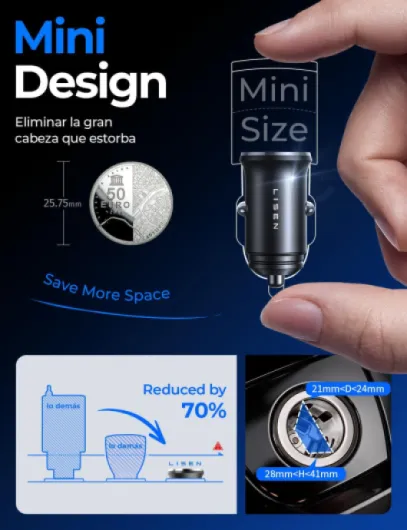
The design is one of the things I actually liked about this charger. It’s small, mostly metal, and doesn’t stick out half a mile from the socket like some older chargers. In my car, it sits almost flush with the dashboard, which means I don’t bang my knee on it or accidentally knock it when reaching for the gear lever or storage area. It has a matte black/obsidian finish that looks decent and doesn’t scream “cheap plastic gadget”. If you care a bit about how the interior of your car looks, this is nicer than the usual shiny plastic blocks with bright logos.
The metal body gives it a solid feel in the hand. It’s not heavy, but it doesn’t feel hollow either. Compared to my previous plastic charger, this one feels much more robust. The downside of this snug, solid design is that in one of my cars, it’s actually slightly too tight to pull out easily. You can remove it, but you need to pinch it properly and give it a bit of a wiggle. If you have big fingers or a recessed socket, it might be slightly annoying. Once it’s in, though, it doesn’t move or rattle, even on bad roads.
There’s a small indicator light around the ports so you can see where to plug in at night. The light is not blinding, which I appreciate. Some chargers have LEDs so bright they light up half the cabin like a nightclub. This one is more discreet. You can see it, but it doesn’t reflect annoyingly on the windscreen. Both ports are clearly labelled (PD for USB‑C and QC for USB‑A), so you know which one to use for faster charging if you care about that.
In terms of day-to-day handling, you just plug in and forget about it. No loose caps, no moving parts. The finish hasn’t scratched or chipped yet despite throwing it in the glovebox a few times between cars. Overall, the design is simple but practical: compact, metal, stable in the socket, and not ugly. It does the job without drawing too much attention, which is exactly what I want from a car charger.
Simple packaging, nothing fancy but does the job
The packaging is pretty straightforward. You get a compact box with the charger, the braided USB‑C cable, and a small manual. No plastic overkill, no huge empty space around the product. It looks like they tried to keep it relatively compact, which I appreciate. You open it, pull out the charger and cable, and you’re basically ready to go in under a minute. There’s no complicated setup or anything like that.
The manual is short but clear enough. It explains which port is which (PD vs QC), the power ratings, and a few safety notes. Honestly, most people will probably throw it away after checking which port is the fast one, but at least it’s there if you care about the details. The box itself isn’t premium or fancy, but it’s not trash either. It’s just a normal, decent cardboard box that protects the charger during shipping.
For something like a car charger, I don’t expect crazy packaging anyway. As long as it arrives intact and the cable isn’t bent in some weird way, I’m fine. And that’s the case here: no damage, no missing parts, no mess. If you’re planning to give it as a small gift, it looks clean enough in its box to wrap it and not feel silly about it. It’s not luxury-level presentation, but it doesn’t look cheap and nasty either.
So overall, on the packaging side: nothing special, but effective. It protects the product, it’s not wasteful in size, and you get everything you need to start using it straight away. For a budget-friendly charger, that’s all I really expect.
Build quality and how it holds up with regular use
I haven’t had this charger for years obviously, but I’ve been using it regularly enough to get a feel for how it’s built. The metal casing is the main thing that gives confidence. It doesn’t creak, there are no gaps in the assembly, and the ports don’t feel loose. I’ve plugged and unplugged cables a lot, especially swapping between my phone and my partner’s, and both ports still feel firm. No wobbling connectors or weird angles when you insert the cable.
The included braided USB‑C cable also feels like it will last longer than the usual thin rubber ones. It has reinforced ends and a slightly stiffer feel, which is good in the car because it doesn’t tangle as much and doesn’t kink badly when you close the storage compartment on it. According to the specs it’s rated for a lot of bends, and while I obviously didn’t count, I’ve bent it around the gear lever, handbrake, and door pockets plenty of times and it still looks new. No fraying, no broken strain relief so far.
One small thing to mention: because the charger sits quite flush and fits tightly, if you’re constantly moving it between cars, you might end up putting more stress on the socket or on your fingers than on the charger itself. In my case, the charger is completely fine, but in one car with a slightly worn socket, I can feel that pulling it out is a bit of a fight. I’d probably just buy a second unit if I wanted one in each car permanently rather than swapping it every day.
Given the metal body, the decent cable, and the fact that some Amazon reviews mention it still working fine after a year of daily use, I’d rate the durability as pretty solid for the price. It’s clearly not the flimsy kind that cracks after a month. Time will tell if it lasts the full 2–3 years they promise, but based on how it feels and behaves now, I’m not worried about it dying anytime soon.
Real-world charging speed and behaviour on the road
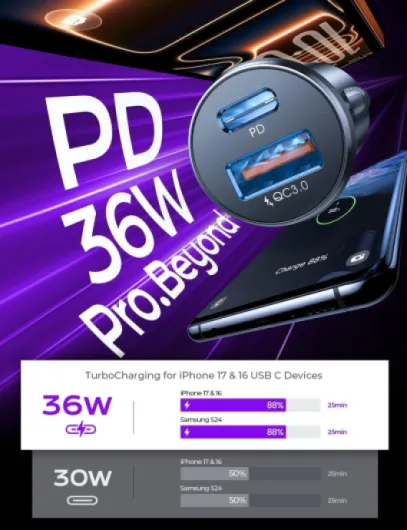
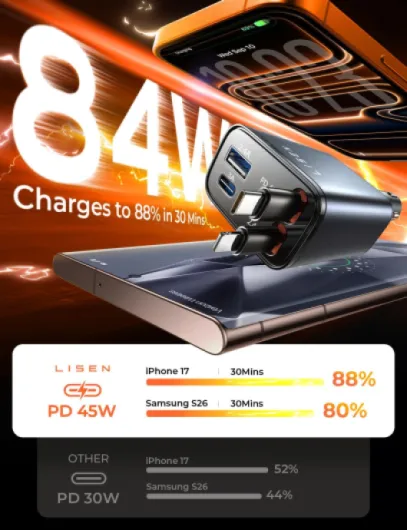
On paper, this charger does up to 36W on the USB‑C port and 18W on the USB‑A port. In practice, with a Samsung phone that supports fast charging, I’ve seen the typical “Super Fast Charging” indicator pop up when plugged into the USB‑C port with the included cable. Starting from around 20%, I got to roughly 80% in about 35–40 minutes while driving, with navigation running and Spotify playing over Bluetooth. So the advertised fast charging is not just marketing, it actually keeps up quite well in that scenario.
When I charged two devices at once (phone on USB‑C and a passenger’s phone on USB‑A), the speed dropped, which is expected. My phone still gained battery, but more slowly, something like 20% to 60% over an hour with navigation on, instead of jumping up quickly. The brand even mentions that it can’t fast charge two devices at full speed at the same time, so at least they’re honest about that. If you mostly drive alone and only occasionally charge a second device, it’s fine. If you always have two heavy users in the car, it’s not ideal for both to get super fast charging.
I also tested it with a dashcam on the USB‑A port and my phone on USB‑C. The dashcam ran normally, and my phone still charged at a decent rate. So for mixed use (one high-power device + one low-power device), it works pretty well. I didn’t notice any glitches, cut-outs, or weird behaviour when starting the car or turning it off. The charger just powers up with the ignition and shuts off with it, like it should.
Heat-wise, the metal body barely got warm, even on a 2-hour motorway trip with my phone charging the whole time while using GPS and streaming. My old plastic charger used to get quite hot and occasionally stop charging for a bit. With the LISEN one, I didn’t have that issue. So from a pure performance point of view: fast on USB‑C alone, decent when sharing, stable connection, and no overheating so far. It’s not magic, but it’s clearly better than the cheap no-name chargers I’d been using before.
What you actually get and how it’s supposed to work
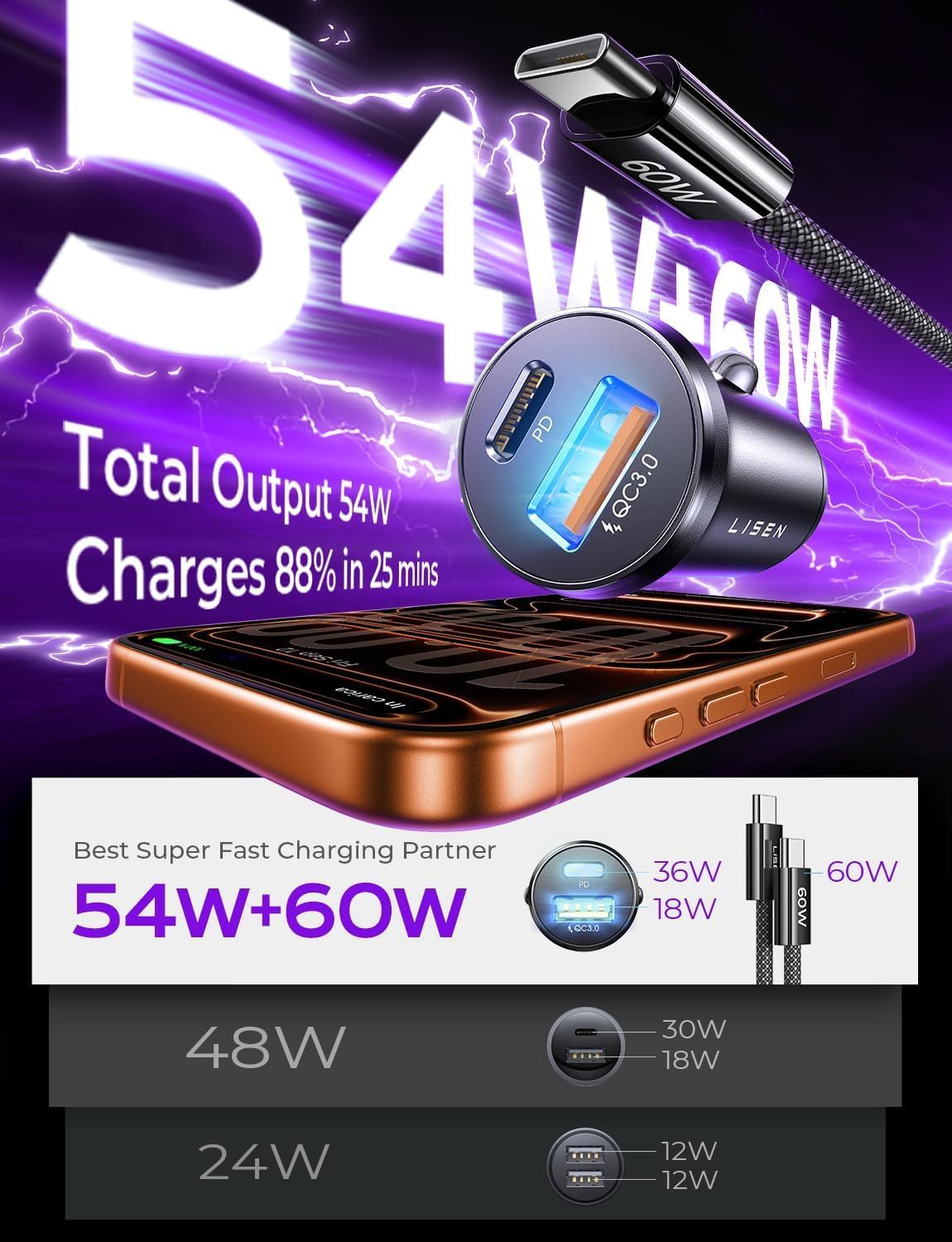
Out of the box, you get three things: the metal car charger itself, a 60W USB‑C to USB‑C braided cable (about 1 metre / 3.3 ft), and a small manual that you’ll probably ignore after checking which port is which. The charger has two ports: one USB‑C PD rated up to 36W and one USB‑A QC rated up to 18W. Together they advertise 54W, but in practice, the fast charging really shines when you use the USB‑C alone. When you share between both ports, the power is split, and it becomes more like a regular charger.
I’ve tested it in two cars with standard 12V cigarette lighter sockets. It fits both without any adapter. You just push it in until it stops, and a small ring light shows it has power. No fancy screen, no extra buttons. It’s very straightforward. The brand shouts about all the certifications (CE, RoHS, etc.) and safety stuff like short-circuit protection and temperature control. I obviously can’t test all of that in detail, but at least nothing has overheated, smelt burnt, or glitched so far, even after long motorway drives with continuous charging.
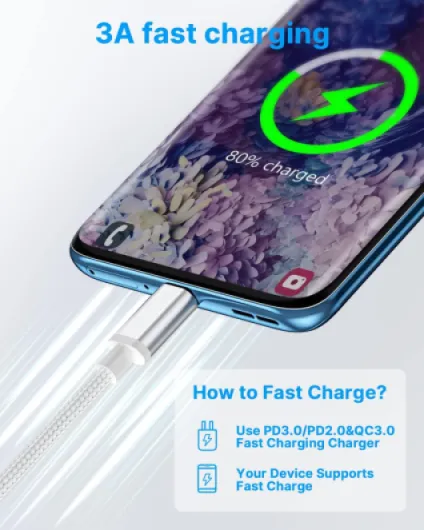
The included cable is a nice touch. It’s USB‑C to USB‑C, supports up to 60W, and feels much sturdier than the random cables you often get with cheap accessories. One important detail though: if you’re on an iPhone with a Lightning port (older models, pre‑USB‑C), this included cable is useless to you. You’ll need your own Lightning cable and will be using either the USB‑A port or a USB‑C to Lightning cable. For newer iPhones with USB‑C, you’re good, the cable works fine.
In terms of claimed compatibility, it’s basically “anything with USB‑A or USB‑C”: phones, tablets, dashcams, Bluetooth speakers, Nintendo Switch, etc. I’ve used it with a dashcam and a phone at the same time, and everything behaved normally. Just don’t expect it to charge a big USB‑C laptop properly – it can add some battery slowly, but 54W total is borderline for real laptop charging while using the laptop. For phones and tablets, though, it’s totally fine.
Pros
- Genuinely fast charging on the USB‑C port when used alone
- Sturdy metal build and compact design that sits almost flush in the socket
- Included 60W braided USB‑C cable is good quality and useful for modern phones and tablets
Cons
- Very tight fit in some sockets, can be awkward to pull out
- Fast charging drops noticeably when two devices are plugged in at once
Conclusion
Editor's rating
Overall, the LISEN 54W USB‑C car charger is a solid bit of kit if you’re tired of flimsy plastic chargers that barely keep up with modern phones. The good points are pretty clear: metal body, compact size, stable connection in the socket, and genuinely fast charging on the USB‑C port when used alone. The included 60W braided USB‑C cable is also a real plus, especially if you’re already on a USB‑C phone or tablet. It feels like a product you can install and forget, rather than something you’re constantly fiddling with.
It’s not perfect though. It fits very snugly in some sockets, so pulling it out can be a bit annoying. And while it can charge two devices at once, don’t expect full-speed fast charging on both – the power is shared, and you feel the slowdown. If you’re often charging two power-hungry phones from low battery, you might want something with more total wattage. Also, the included cable is useless for older Lightning iPhones, so you’ll still need your own cable in that case.
Who is it for? People who use navigation, streaming, and Bluetooth a lot and need their phone to actually gain battery while driving, not just stay flat. Also good for anyone who wants a charger that doesn’t look or feel cheap and is likely to last. Who should skip it? If you’re on a tight budget and only trickle-charge a basic phone, a cheaper charger will do. Or if you absolutely need fast charging for two heavy devices at the same time, you should look at higher-power models. For most everyday drivers though, this is a pretty solid, reliable option at a reasonable price.
![USB C Charger Cable - [2-Pack 2M] 3.1A Fast Charger USB C Right Angle USB to USB C Cable Nylon Braided for iPhone 17/16/15 Samsung Galaxy S25 S24 S23 S22, Gifts for Him Men Women 6.6FT+6.6FT Grey 2](https://www.fashion-men-magazine.com/storage/937976/conversions/71IKU-aXNSL._AC_SL1500_-medium.webp)