
Summary
Editor's rating
Is this 2‑pack worth the money?
Right‑angle plug: simple idea that actually helps
Braided nylon and reinforced ends: feels tougher than the usual cheap stuff
How it holds up to daily abuse
Charging speed and data: decent, but not a rocket
What you actually get in the box
Pros
- Sturdy braided nylon build with reinforced connectors that feels much tougher than basic rubber cables
- Right‑angle USB‑C plug makes it easier and more comfortable to use the phone or tablet while charging
- 2m length on both cables is very practical for sofa/bed use and awkward power outlets
Cons
- USB‑A to USB‑C with 3.1A limit, so it doesn’t take full advantage of modern high‑wattage USB‑C fast charging
- Right‑angle connector direction might be awkward depending on how your device or outlet is positioned

Specifications
View full product page →| Brand | AINOPE |
A cable you buy once and forget about (in a good way)
I’ve been using AINOPE cables for a while now, and this 2‑pack of 2m right‑angle USB‑A to USB‑C cables fits right into what I expect from them: simple, sturdy, and not overpriced. I grabbed this set to replace a bunch of random cheap cables around the house that kept fraying near the connector or getting loose after a few months. My main use is charging a Samsung phone, a Pixel, and a USB‑C iPad, plus the odd controller.
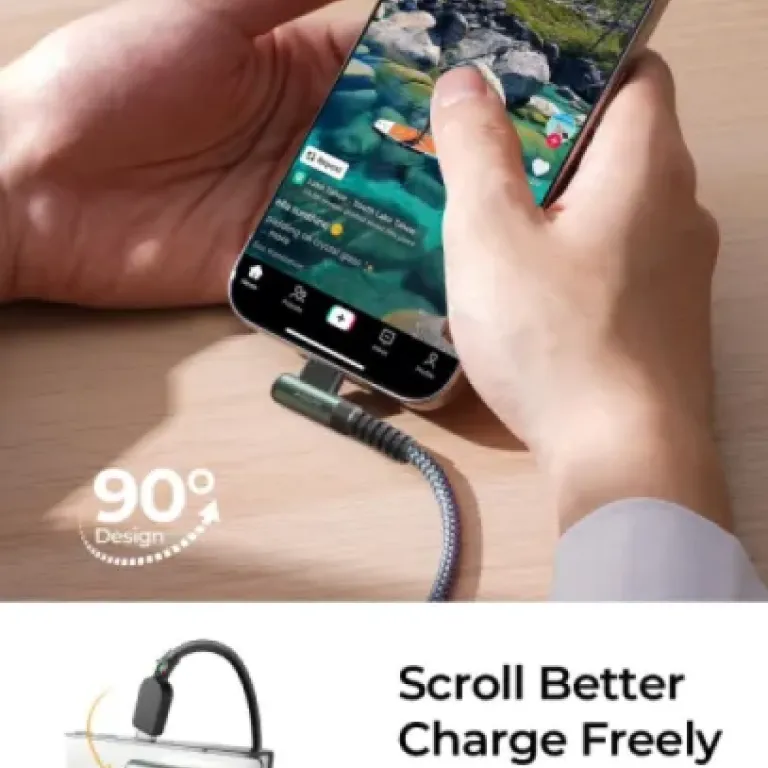
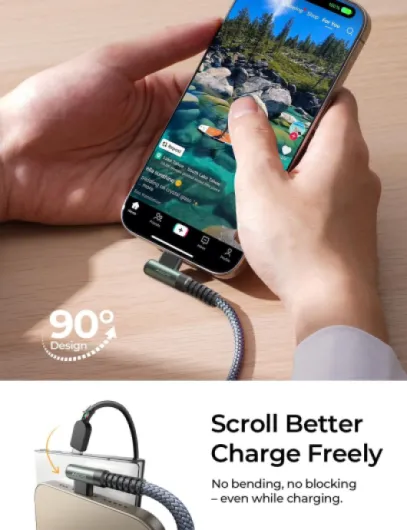
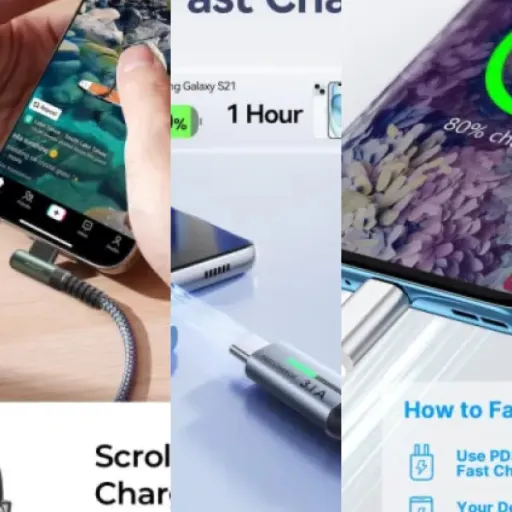
What pushed me to try this specific pack was the combo of 2-metre length and the 90° right‑angle connector. I’m often charging while on the sofa or in bed, and straight connectors always end up bent, or the cable sticks out awkwardly. With this design, the cable runs along the edge of the phone instead of jutting straight out, which instantly feels more natural when you’re holding it.
I’ve used these cables daily for a few weeks: one stays by the bed, the other lives in the living room plugged into a regular USB wall adapter. So far, they’ve handled constant plugging, unplugging, and a few good yanks from kids tripping over them. No loose connectors, no visible damage, and no weird charging drops so far. They behave like a decent, reliable cable should.
If you’re expecting some miracle ultra‑fast charging solution, this isn’t that. It’s a solid 3.1A USB‑A to USB‑C cable, which is fine for everyday phones and tablets but not meant to unlock full fast‑charge speeds on something like a modern flagship with a high‑wattage USB‑C charger. But if you just want long, tough cables that you don’t have to baby, this pack is already looking pretty good.
Is this 2‑pack worth the money?
Price-wise, this AINOPE 2‑pack usually sits in the mid‑range for USB‑A to USB‑C cables. You can definitely find cheaper no‑name cables, but they usually come with thin rubber coating, basic straight connectors, and no real focus on durability. On the other side, you’ve got brand-name cables from phone manufacturers or big accessory brands that cost more per cable than this whole 2‑pack. So AINOPE lands in that sweet spot where you’re paying a bit extra for sturdier build without going into premium brand pricing.
What you actually get for the money is: two long 2m cables, a braided jacket, reinforced connectors, and a right‑angle design that genuinely makes everyday use nicer. If you were going to buy two decent cables anyway — one for the bedroom and one for the living room, for example — this pack makes sense. You’re basically paying for peace of mind that you’re not back on Amazon in three months looking for another emergency replacement because the last one split at the connector.
That said, if you specifically need very fast charging with USB‑C PD for a modern phone or laptop, this is not the most cost‑effective choice. You’d be better off putting your money into a proper USB‑C to USB‑C cable rated for higher wattage, plus a matching charger. This AINOPE set is more about solid, everyday reliability than squeezing every possible watt out of your charger.
For most people who just want a couple of cables that get the job done and last longer than the cheap stuff, the value is good. You’re not paying for fancy branding, just better materials and a smarter connector shape. In my opinion, if you’re already fed up with low-quality cables dying on you, spending a bit more on this 2‑pack is reasonable and makes sense over time.
Right‑angle plug: simple idea that actually helps
The main design feature here is the 90° right‑angle USB‑C connector. In practice, this matters more than it sounds. With a normal straight connector, the cable sticks straight out of the bottom of the phone or tablet, so when you’re lying in bed or holding the device sideways, the cable is always getting bent near the plug. Over time, that’s usually where the cable breaks. With this right‑angle design, the cable runs sideways along the device, so there’s less sharp bending at the connector.
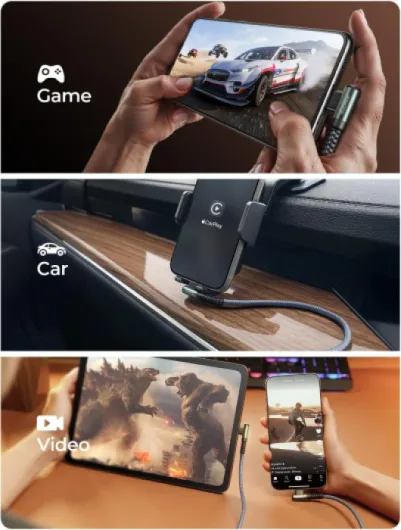
Using it while watching videos or gaming, especially in landscape mode, is noticeably nicer. I can rest the phone on my stomach or in my hands without the plug digging into my palm or pushing against the cable. For my kid playing games on a tablet while it charges, it also feels safer — the connector doesn’t stick out as much, so it’s less likely to get snapped if the device is dropped or pushed into the sofa.
Visually, the cable is pretty low‑key. It’s grey braided nylon with metal ends. It looks more like a mid‑range accessory than a cheap throwaway cable. There’s no big branding screaming at you, just a small logo on the connector. The right‑angle piece is slightly bulkier than a normal plug, but not so much that it blocks nearby ports on most devices. On my phone with a case, it fits fine; on a thicker rugged case, it’s a tighter fit but still works.
If I had to nitpick the design, the only thing is that the right‑angle connector locks you into one direction. Depending on how your socket or device is positioned, sometimes you might wish the angle was the other way around. It’s not a big deal, but if your charging situation is awkward, this can be slightly annoying. Overall though, for handheld use on the sofa or in bed, the design choice makes sense and genuinely improves comfort and durability.
Braided nylon and reinforced ends: feels tougher than the usual cheap stuff
The cable uses a nylon braided outer layer, and you can feel the difference compared to the glossy rubber cables that come with many devices. The braid gives it a slightly rough, grippy texture, which actually helps when you’re trying to grab it behind the bed or under a desk. It also means it doesn’t tangle as easily; when I pull it out of a bag, it uncoils pretty cleanly instead of forming tight knots.
Near both connectors, there’s a reinforced strain relief section. This is the area that usually starts to crack on cheap cables. Here, it’s thicker and feels firm but still bendable. I’ve done a few deliberate stress bends right at that point to see if the braid or the rubber would separate, and so far nothing has moved or loosened. That gives me a bit more confidence that these will last longer than the usual budget cable I’d get in a supermarket.
The connectors themselves are metal‑shelled, not thin plastic. They feel solid when you plug them in — no wobble, no feeling like the inner part is going to snap off inside the port. The USB‑C plug fits snugly in my devices without being overly tight. After repeated plugging and unplugging, it still clicks in firmly, so the tolerances seem decent. On the USB‑A side, same story: it slides into charger bricks and hubs without feeling loose.
Is it the toughest cable on earth? Probably not, and there are heavier-duty options out there with even thicker sheathing. But for the price, the materials feel pretty solid. If you’re used to basic rubber cables that split after a few months, this is a visible upgrade in terms of build and feel. I’d still avoid slamming it in doors or rolling office chairs over it, but for normal home use with kids and travel thrown in, the materials seem up to the task.
How it holds up to daily abuse
Durability is the main reason I even bother paying attention to cables like this. I’m tired of replacing flimsy ones every few months, especially around kids. Over the last couple of weeks, these AINOPE cables have seen pretty normal household abuse: pulled from across the bed, stepped on, twisted behind a nightstand, and used by kids who don’t gently unplug anything. So far, there are no visible signs of wear — no fraying braid, no loose connector, no kinks that stay bent.
The braided nylon definitely helps here. When the cable gets pinched between the bed frame and the wall, the braid just flattens a bit and goes back to normal. With plain rubber cables, I usually see a white stress mark or the outer layer starting to split. Also, the right‑angle connector seems to take a lot of stress off the weak point where the cable enters the plug, because it’s not constantly bent in a sharp U‑shape while you hold the phone.
I also tried wrapping the cable tightly for travel, looping it several times and stuffing it into a bag. When I unwrapped it, there were no permanent twists or damage. It’s flexible enough to coil, but not so soft that it feels flimsy. After several plug/unplug cycles each day, both ends still click in firmly. I don’t feel any looseness inside the connector when I wiggle it, which is usually a bad sign on cheaper cables.
Obviously, I can’t simulate a full year of use in a short test, but comparing it to other cables I’ve had that started failing within a month, these feel more trustworthy. The Amazon reviews mentioning long-term use without issues line up with what I’m feeling so far. I’d still say: if you’re very rough with your stuff, nothing is unbreakable, but for normal to slightly careless everyday use, durability looks like one of the strong points of this product.
Charging speed and data: decent, but not a rocket
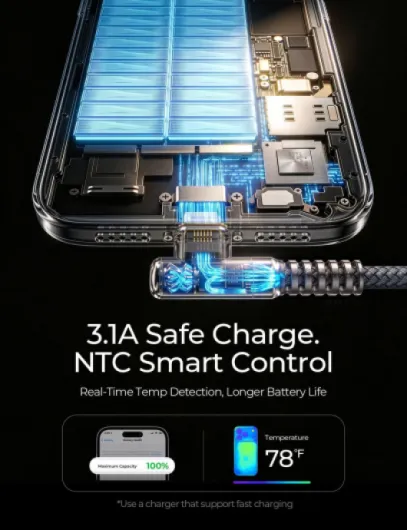
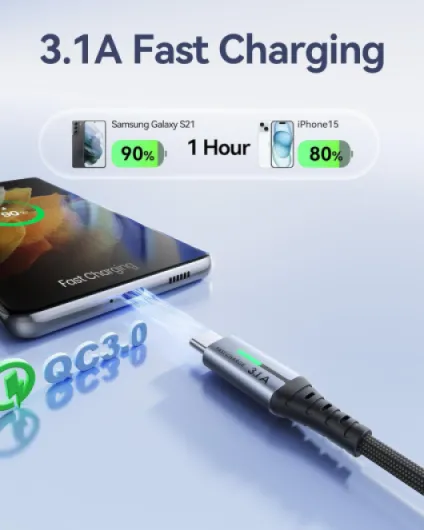
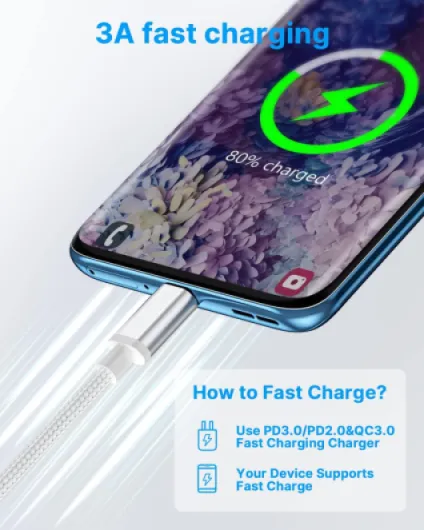
On paper, these cables support up to 3.1A at 5V and data transfer up to 480 Mbps. In normal terms, that means: fine for everyday fast-ish charging via USB‑A, and basic USB 2.0 data speeds. I tested them with a few wall chargers and power banks that I already own. With my Samsung Galaxy S22 on a standard Samsung USB‑A fast charger, the phone reported its usual fast charge message and the time estimates matched the original cable pretty closely.
On a Google Pixel and an older USB‑C iPad, the behavior was similar: charging speeds felt normal, not slow, but also not the high‑wattage speeds you get with a proper USB‑C PD charger and cable. That’s not the cable’s fault; it’s just the limitation of the USB‑A to USB‑C setup. If you’re coming from a totally worn‑out or very cheap cable that barely charges, you’ll probably feel this as an upgrade. But if you’re used to modern 25W–45W USB‑C PD charging, this will feel more like “standard fast” rather than “blazing fast.”
For data, I shifted some photos and a couple of video files between my phone and laptop. Speeds were what you’d expect from USB 2.0 — not instant, but fine for occasional transfers and backups. If you regularly move big 4K videos or huge folders, this isn’t the ideal cable for that; you’d want a proper high‑speed USB‑C to USB‑C cable. For syncing music, documents, and normal photos, it’s totally acceptable.
One thing I did notice in a positive way: no overheating or random disconnects. Some cheap cables get warm near the connector or drop the charge for a second when you move the phone. Here, even when using the phone while charging, the connection stayed stable and the plugs didn’t heat up more than slightly warm. So overall, performance is solid and consistent, just don’t expect it to magically speed up your device beyond what your charger and phone already support.
What you actually get in the box
In this specific listing, you’re getting a 2‑pack of 2m (6.6 ft) cables, both the same length, both in grey, both with a right‑angle USB‑C connector on one end and a standard USB‑A on the other. So it’s not a fancy mixed-length kit — you’re basically equipping two spots in your home or office with the same long cable. For me, that’s perfect: one for the bedroom, one for the sofa/desk area.
The cables are rated for 3.1A and 480 Mbps. That basically means: normal fast charging for older or mid‑range devices and basic data transfer, not high‑end power delivery or super fast file transfers. Don’t expect laptop-level USB‑C performance; this is more for phones, tablets, controllers, and light use. I tested it with a Samsung Galaxy S22, a Google Pixel, and an older iPad Pro with a USB‑C port, all using a standard USB‑A charger block. They all charged at a decent speed, similar to other good USB‑A to USB‑C cables I own.
The brand pushes the whole 45,000 bend test thing and the braided nylon jacket. Obviously, I didn’t sit there counting bends, but I did a bit of rough handling: tight wrapping for travel, bending it sharply near the connector, and letting the kids use it (which is usually the real stress test). After that, there’s no fraying, no soft spots, and no sign of the outer layer splitting, which is where cheap cables usually start to die.
Overall, in terms of what’s promised versus what you get, it’s pretty straightforward: two long, tough cables for everyday charging and syncing. No fancy extras, no weird gimmicks. If you understand that this is a USB‑A to USB‑C cable with moderate fast charge, the product matches the description fairly well.
Pros
- Sturdy braided nylon build with reinforced connectors that feels much tougher than basic rubber cables
- Right‑angle USB‑C plug makes it easier and more comfortable to use the phone or tablet while charging
- 2m length on both cables is very practical for sofa/bed use and awkward power outlets
Cons
- USB‑A to USB‑C with 3.1A limit, so it doesn’t take full advantage of modern high‑wattage USB‑C fast charging
- Right‑angle connector direction might be awkward depending on how your device or outlet is positioned
Conclusion
Editor's rating
The AINOPE USB C Charger Cable 2‑pack is basically for people who are tired of flimsy cables but don’t want to spend silly money on big-brand accessories. The right‑angle connector, the braided nylon, and the reinforced ends all point in the same direction: this is built to survive normal daily abuse, sofa charging sessions, and kids yanking on devices while they’re plugged in. Charging speed is decent for USB‑A to USB‑C — not the fastest tech out there, but stable and predictable.
If your setup is mostly phones, tablets, controllers, and you just need a couple of long, tough cables around the house, this set makes sense. You get two 2m cables that feel solid in the hand and don’t look or behave like disposable junk. On the other hand, if you’re chasing top-tier fast charging for a flagship phone or need to charge a laptop at full speed, this is not the right product — you should look at proper USB‑C to USB‑C, high‑wattage cables instead.
Overall, I’d say these AINOPE cables are good value for everyday users who care more about durability and comfort than squeezing the last bit of charging speed. Not perfect, but for the price, they’re a pretty solid upgrade over generic cables.
![USB C Charger Cable - [2-Pack 2M] 3.1A Fast Charger USB C Right Angle USB to USB C Cable Nylon Braided for iPhone 17/16/15 Samsung Galaxy S25 S24 S23 S22, Gifts for Him Men Women 6.6FT+6.6FT Grey 2](https://www.fashion-men-magazine.com/storage/937976/71IKU-aXNSL._AC_SL1500_.jpg)